Anticipating tourist flow through AI: sales forecasting for the Valencia Tourist Card
On this occasion, and once again in collaboration with Visit Valencia and as part of the Citcom.ai project, our IDAL's (Intelligent Data Analysis Laboratory) research team from the University of Valencia has worked on a use case focused on one of the key elements of tourism in the city: the Valencia Tourist Card (VTC). These cards not only facilitate urban mobility and access to museums and activities, but also generate a daily sales record which, when properly analysed, can become a strategic tool for tourism management.
Therefore, the objective of the project was clear: to take advantage of this historical VTC sales data and apply an AI-based tool developed by our team to predict how many cards will be sold in the future, not only in general terms, but also broken down by specific areas of the city.
Having these predictions opens the door to anticipating actual demand and acting accordingly: planning marketing campaigns with greater precision, reinforcing services where necessary, launching tailored offers or adjusting resources according to expected flows. In short, it is a way of anticipating visitors' needs and improving their experience from the outset.
From historical data to predictive models
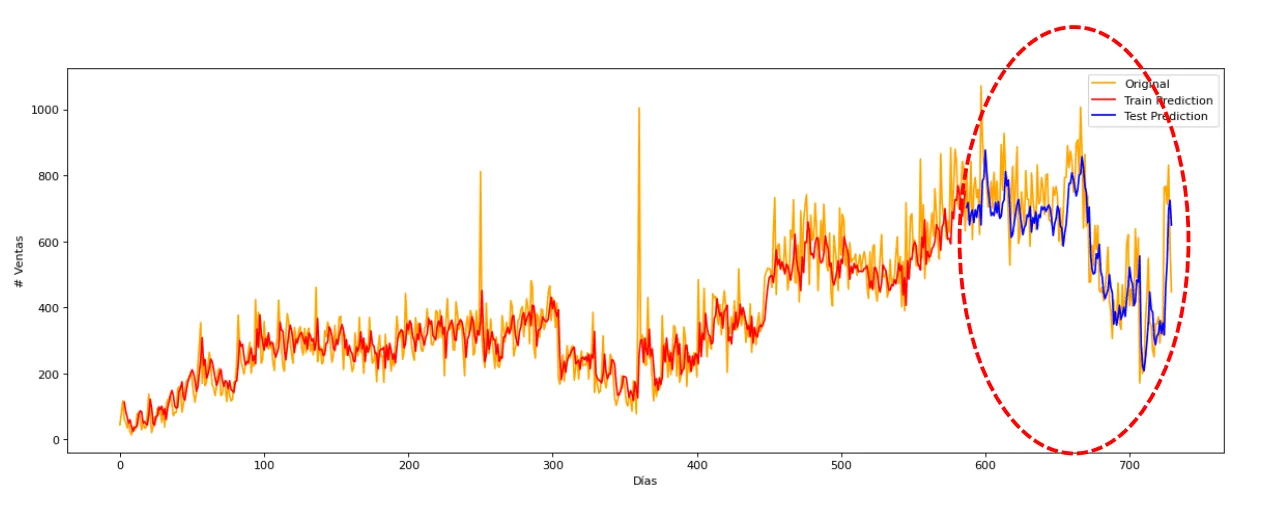
To do this, a time series of 730 days was analysed, covering sales over two full years. Of this set, 584 days were used to train the model—that is, to teach it the patterns of sales behaviour—while the remaining 146 days were reserved as a test set, allowing us to check whether the model is capable of correctly predicting situations it has never seen before. This separation is essential for assessing whether the predictions are reliable before considering a real-world application.

Although the project relies on advanced time series forecasting techniques, the central idea is simple: if we understand how sales evolve on a day-to-day basis, taking into account marketing factors and other elements that influence demand, we can generate a fairly accurate estimate of what will happen in the immediate future.
Initial results show that the predictions reasonably follow the actual evolution of sales, especially in periods marked by stable or repetitive patterns. This opens the door to using these techniques to support tourism planning, helping to avoid saturation, improve resource distribution, and adapt supply to expected visitor flows.
This use case demonstrates, once again, the potential of Artificial Intelligence to promote more coordinated, efficient tourism that is geared towards the real needs of the city and its visitors. If you would like to learn more about this tool or think that a similar one could be useful for your project or business, please contact us!
The authors would like to thank the Regional Ministry of Innovation, Industry, Trade and Tourism (Conselleria d'Innovació, Indústria, Comerç i Turisme de la Generalitat Valenciana) for its funding under Grant Agreement No. 101100728, as part of the European Commission’s Citcom.ai project.