Detection of abnormal water consumption in Valencia using AI: a new step towards more efficient and sustainable water management
Water is an essential resource for any city, and its consumption directly reflects urban functioning: neighbourhood habits, seasonal needs, possible leaks, technical failures or unexpected peaks in demand. In a context of growing concern for sustainability and resource optimisation, having tools capable of detecting anomalous patterns is essential for acting quickly and preventing major problems.
To this end, our IDAL's (Intelligent Data Analysis Laboratory) research team from the University of Valencia has developed, within the framework of the Citcom.ai project, a use case focused on the automatic detection of abnormal water consumption in different neighbourhoods of the city.
An analysis based on real data provided by Valencia City Council.
The project was carried out using daily water consumption records provided directly by Valencia City Council and collected between June 2022 and September 2024. Each neighbourhood in the city has its own time series, which allows for accurate analysis of how demand evolves in each area and detection of irregularities that may go unnoticed at first glance. Unlike other studies, this database was already clean and had no missing values, which meant that the analysis models could be applied directly without the need for a prior cleansing phase.

The methodology developed is based on an ensemble approach that combines different time series analysis techniques. Although each neighbourhood has its own consumption patterns, using several models allows different types of anomalies to be detected: from unusual consumption peaks to periods of abnormally low demand or behaviour that could indicate meter failures.
The system detects these irregularities without the need for labelled data, making it particularly useful for discovering new problems or episodes that have not occurred before. To facilitate interpretation, the results are visualised using an interactive map that allows neighbourhood-by-neighbourhood exploration of consumption series and detected anomalies, as well as offering an aggregated view of the entire city under the label ‘Valencia City’.
This use case is a first step towards building more comprehensive monitoring tools, which are particularly relevant in a scenario of climate change and increasing pressure on urban water resources. Early detection of unexpected consumption not only allows for the identification of possible leaks or faults in the network, but also helps to better understand actual usage patterns in each neighbourhood, anticipate future needs and support more sustainable water management. In addition, the results obtained will be used for further work analysing water consumption and tourist activity together, exploring possible relationships between seasonality, visitor flow and variations in demand.
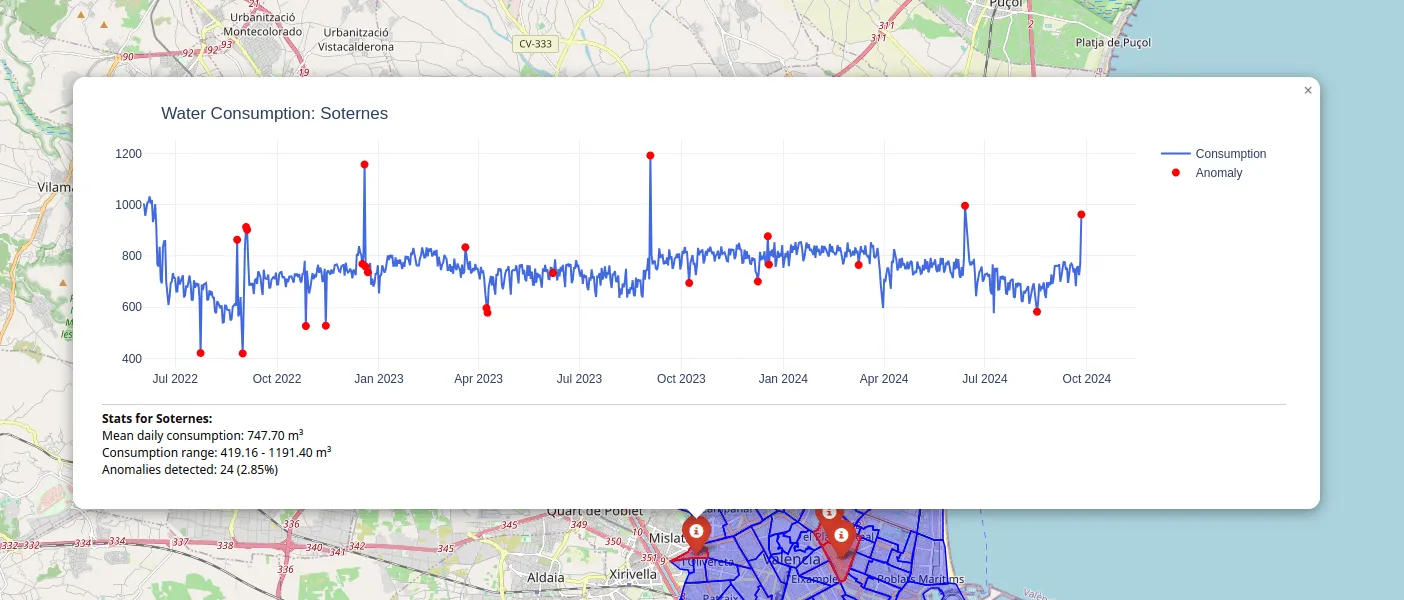
Although this is an evolving project and currently based on offline data, it lays a solid foundation for moving towards systems capable of operating more frequently, or even in near real time if more frequent updates were available. As new data is incorporated and models are refined, this tool could become a key support for urban planning and informed decision-making on sustainability and water management.
You can access the tool here, and the scientific article in the journal City and Environments on this use case through this link.
If you find this type of analysis useful for better understanding the behaviour of urban resources—or if you believe that a similar tool could add value in your environment—we would be happy to discuss it with you and explore possible applications and developments. You can contact us through our contact section.
The authors would like to thank the Regional Ministry of Innovation, Industry, Trade and Tourism (Conselleria d'Innovació, Indústria, Comerç i Turisme de la Generalitat Valenciana) for its funding under Grant Agreement No. 101100728, as part of the European Commission’s Citcom.ai project.