Intelligent urban traffic prediction in Valencia through AI: anticipating mobility for a more efficient and sustainable city
Managing traffic in a large city is a constantly changing challenge: rush hours, weather changes, local events and seasonal variations make urban mobility a difficult system to anticipate. This makes it one of the biggest challenges for any local authority.
Therefore, to support Valencia City Council in managing this problem, which our city faces on an increasingly daily basis, our IDAL's (Intelligent Data Analysis Laboratory) research team at the University of Valencia, as part of the Citcom.ai project, has developed a use case focused on early traffic prediction using Artificial Intelligence, with the aim of improving decision-making and moving towards more efficient and sustainable mobility. The development of this tool is based on Vicente López Asensio’s final-year degree project, which was supervised at the ETSE-UV by academic staff involved in this project.
An approximation based on urban data and hybrid prediction models
The aim of the project was to build a system capable of predicting, with horary precision, traffic intensity, congestion and speed at different points in the city. To do this, historical data from urban mobility sensors was integrated with external variables that directly influence traffic patterns, such as weather and events.

The approach combines classic time series models with advanced machine learning techniques, allowing both seasonal dynamics and complex relationships between multiple factors affecting traffic behaviour to be captured. Prior to training, an exhaustive data cleaning and preparation phase was carried out, including the imputation of missing values and the consolidation of records from various sources, in order to ensure the quality of the predictions.
The results of the use case show that it is possible to anticipate the traffic situation with a level of detail that was not previously available. The predictions are represented by urban heat maps that allow areas that could experience congestion to be identified, well in advance, and thus facilitating the adoption of preventive measures.
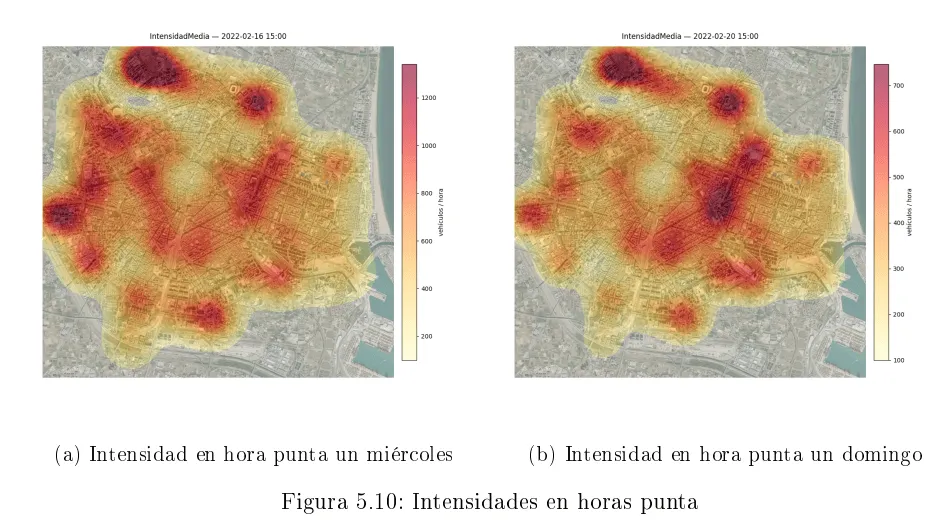
This tool opens the door to multiple practical applications: from optimising traffic management and planning more efficient routes to creating early warning systems that alert users to potential traffic jams before they occur. It also provides valuable support for public policies aimed at sustainable mobility, as it allows resources to be adjusted, certain sections of the network to be reinforced, and the impact of events to be assessed in real time.
Although there are still challenges related to the quality and consistency of some sensors, the methodology developed is robust and easily extensible. The system could be adapted to new variables, integrated into municipal platforms, or applied to other cities with similar needs. Furthermore, its potential goes beyond the institutional sphere, as it could also benefit logistics operators, transport companies, or entities responsible for organising events.
Overall, this use case demonstrates how Artificial Intelligence can transform urban management in a practical and tangible way. Reliable predictions make it possible to anticipate problems rather than react to them, as was the case with the technology available until now, optimise resources and move towards a more efficient, prepared and citizen-friendly mobility model. The collaboration between Valencia City Council, the Citcom.ai project and our research team reinforces the commitment to a smarter city that is better connected to the real needs of those who live in and visit it.
If you found this article interesting and would like to learn more, or if you think we can help you create a similar solution for your business or municipality, please contact us! You can find out how to do so in the contact section of this website.
The authors would like to thank the Regional Ministry of Innovation, Industry, Trade and Tourism (Conselleria d'Innovació, Indústria, Comerç i Turisme de la Generalitat Valenciana) for its funding under Grant Agreement No. 101100728, as part of the European Commission’s Citcom.ai project.