VLC Chatbot: the 24/7 personal guide to simplify tourism in Valencia
In collaboration with Visit Valencia, a non-profit foundation promoted by Valencia City Council and various public entities, our IDAL's (Intelligent Data Analysis Laboratory) research team from the University of Valencia has developed, within the Citcom.ai project, a new use case for Artificial Intelligence applied to tourism: VLC Chatbot, an intelligent conversational assistant designed to offer useful and personalised information to tourists visiting the city.
Every year, thousands of visitors arrive in Valencia eager to discover its history, gastronomy and culture. However, the excess of information on the internet can make planning a trip a confusing and exhausting experience. Between blogs, reviews, guides and social media, travellers are faced with contradictory or even outdated information about activities, accommodation and restaurants.
VLC Chatbot was born out of this problem, which is becoming increasingly common in the tourism sector in general and in Valencia in particular, a city currently undergoing rapid growth. The objective is therefore clear: to respond to this problem by offering a single, reliable and always available source of tourist information about the city that simplifies trip planning.
From information overload to accurate and verified answers
The system works like a personal guide in the visitor's pocket, available 24 hours a day. Through a simple, conversational interface, users can ask anything from ‘How much does it cost to visit the Serranos Towers?’ to ‘What restaurants are there near the City of Arts and Sciences?’, obtaining clear and verified answers instantly.
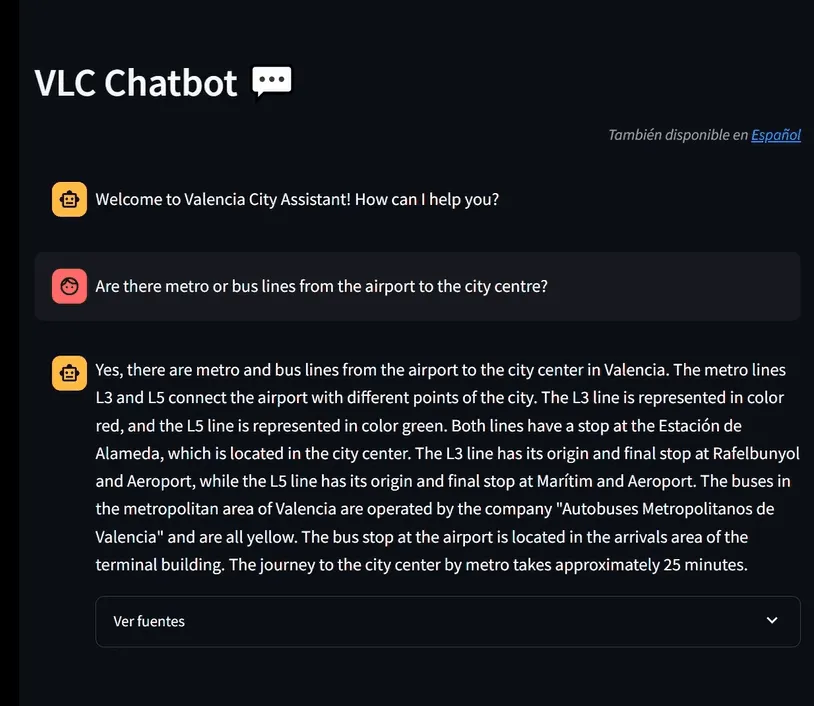
Its knowledge comes from verified sources, such as the official Visit Valencia guides, supplemented with historical information from Wikipedia and other reliable resources. Instead of improvising answers, the chatbot first searches its library of official documents and, based on that search, constructs an accurate and coherent response. Thanks to this data curation, the risk of the well-known hallucinations or errors typical of some AI systems is minimised, ensuring that the information provided is always accurate, up-to-date and contextualised.
Furthermore, VLC Chatbot is not limited to maintaining a conversation: it can consult external tools to enrich its responses. It is capable of locating places on a map, calculating distances or showing nearby points of interest in real time, and even accessing complementary sources when it needs to expand on a response. All of this is integrated into an easy-to-use web application, which unifies the system into an intuitive, accessible and user-friendly interface.
The application is currently in the pilot phase, but it has already proven its effectiveness in internal tests and can be tried out via the following link: VLC Chatbot.
In addition, a scientific article has been published about it, which you can read if you are interested at the following link: An Agent-Based RAG Architecture for Intelligent Tourism Assistance: The Valencia Case Study.

Its development marks an important step towards the future of smart tourism. These types of tools have a direct impact on the experience of those who visit Valencia, improving interaction with the city, reducing uncertainty and facilitating travel planning. Overall, the project reinforces Valencia's position as a leading Smart City, committed to innovation and digitalisation at the service of people.
If you liked this article and want to know more — or think we can help you develop a similar solution for your business — get in touch! You can find all the information you need in our contact section.
The authors would like to thank the Regional Ministry of Innovation, Industry, Trade and Tourism (Conselleria d'Innovació, Indústria, Comerç i Turisme de la Generalitat Valenciana) for its funding under Grant Agreement No. 101100728, as part of the European Commission’s Citcom.ai project.